Competitive intel with Grok Bot
A cloud competitive intelligence agent that scrapes the web and LinkedIn, filters for material signals, and posts a daily Slack digest — in about 30 minutes.
Grok Bot is pretty awesome, guys.
I tested it to see if I could spin up a competitive intelligence agent that scrapes public websites and LinkedIn, filters for material signals, and posts a daily digest to Slack. I also needed the agents running in the cloud so my laptop doesn’t need to be on.
Took me about 30 minutes.
It gives me the same excitement as OpenClaw but without all the headaches and troubleshooting. Highly recommend checking it out.
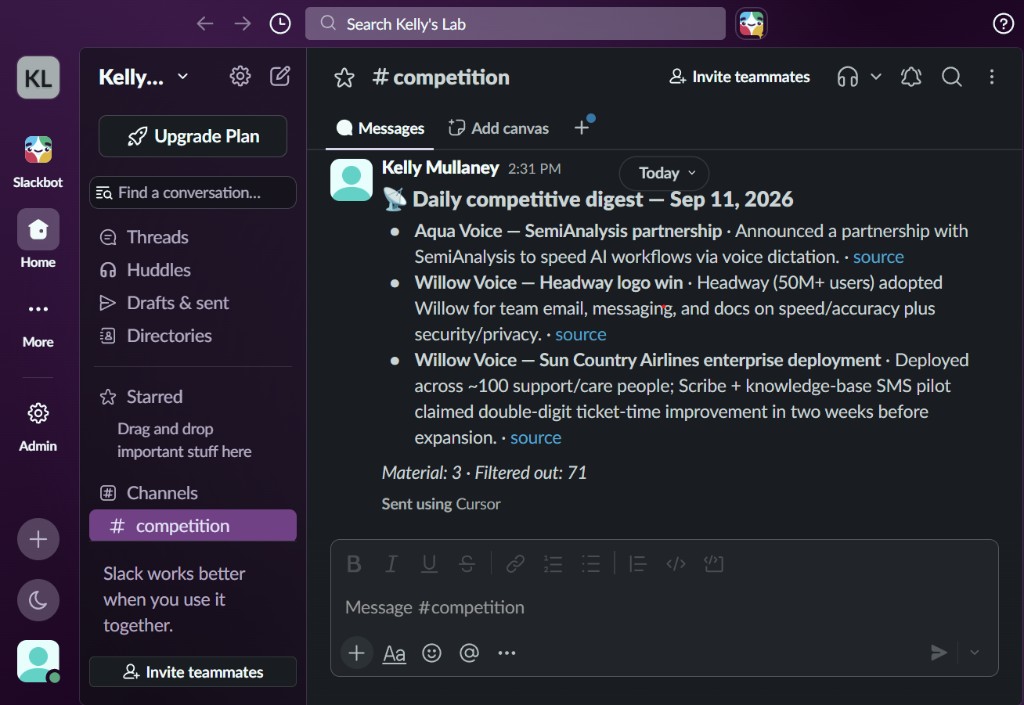
Here’s a basic prompt if you want to build the same thing — copy it and paste it into Grok Bot:
Build a cloud-scheduled competitive intelligence system in Grokbot for a Product team.

## Goal
Every weekday morning, automatically gather competitive signals about a defined watchlist, filter hard for material news only, dedupe so nothing posts twice, and post a short digest to a Slack channel — even if my laptop is off.

## Inputs I will provide (or ask me for these first)
- Home company name (for framing only; do NOT include home-company news in the competitor digest)
- Competitor watchlist: [COMPETITOR_1], [COMPETITOR_2], [COMPETITOR_3], … (paid / material peers only — exclude freeware / open-source-only noise unless I say otherwise)
- Slack destination channel name (and resolve its channel ID)
- Preferred daily run time / timezone (default: weekdays 8:00 AM local)
- Lookback window (default: 14 days)

## Architecture (multi-agent — do not do gather + judge + post in one agent)
1. Orchestrator agent
   - Owns schedule, shared inbox, SQLite dedupe, Slack posting, and coordinating teammates
2. One collector agent PER competitor
   - ONLY gathers raw candidates
   - NEVER classifies materiality
   - NEVER posts to Slack
3. One Signal Classifier / vetting agent
   - ONLY classifies and formats keepers
   - NEVER scrapes
   - NEVER posts to Slack

### Collector responsibilities (each competitor)
For the lookback window, gather raw candidates from ALL of these (web search is first-class, not optional):
- LinkedIn company page posts via Apify (prefer harvestapi/linkedin-company-posts, no cookies; use date filters)
- LinkedIn key-people posts via Apify (prefer harvestapi/linkedin-profile-posts) — CEO/founder/CTO/notable PM, not only the company page
- General web/news search (launches, funding, pricing, M&A, layoffs)
- Product changelogs / blogs / app store / site pages as relevant
- WARN notices for layoffs
- EDGAR for material filings when the company (or parent) is public; otherwise treat as N/A privately — do NOT put empty WARN/EDGAR lines in the Slack post

For each competitor, resolve and store:
- Official LinkedIn company URL
- 1–3 key people LinkedIn profile URLs

Tag each candidate with: competitor, date, short raw summary, source_url, source_type
(linkedin_company | linkedin_profile | web | warn | edgar | changelog | other).

Write candidates to a shared inbox JSON path the orchestrator can read.

### Classifier responsibilities (high bar)
KEEP only:
- Major product launch or category-changing feature
- Pricing/packaging change that affects buyers
- Whale / named enterprise logo win (not generic “we signed a customer”)
- Funding, acquisition, sale, strategic partnership
- Layoffs, org reset, C-level hire/exit
- Rebrand, rename, positioning pivot

DROP always:
- Minor features, polish, bugfix, version-bump fluff
- Webinars, events, hackathon sponsorships, giveaways, marketing CTAs
- Generic hiring / culture posts
- Recycled talk about old launches
- Soft thought leadership with no business fact
- Non-whale customer anecdotes
- Duplicate amplifies of the same announcement

Output:
1) Kept bullets exactly: **Competitor — takeaway** · one sentence · [source](url)
2) Counts: Material: N · Filtered out: M
3) Short drop list (competitor + 1-line reason)
Never invent signals. Never narrate empty sources (“no WARN found”) in the Slack digest.

## Slack digest format
Post to the chosen channel.

Visual structure:
- Large title with emoji: 📡 Daily competitive digest — YYYY-MM-DD
- Bullets ONLY for material hits (no empty-source filler, no “Competitor X had nothing”)
- Quiet footer: Material: N · Filtered out: M
- If zero NEW material items after dedupe: skip the Slack post entirely (stay quiet)

Prefer Slack Block Kit (header + sections + context footer) if available; if the connector is markdown-only, use a # header + italic footer.
Note: posting via the Cursor Slack connector may show “sent via Cursor.” If I need a custom Slack bot identity instead, set that up as a separate path.

## Deduplication (critical)
Do NOT use Slack channel history as the dedupe source of truth.
Use a durable SQLite DB on the agent computer, e.g.:
- posted_signals(fingerprint UNIQUE, competitor, takeaway, source_url, posted_at, digest_date, slack_channel_id)
- run_stats(digest_date, material_count, filtered_count, posted_count)
Fingerprint = hash(canonical source_url + competitor + takeaway).
Each run: gather → classify → drop fingerprints already in DB → post only net-new → write new rows.

## Schedule
Create a Grokbot routine on weekdays at the agreed time.
Orchestrator kicks all collector agents → waits for handoffs → sends combined inbox to classifier → dedupes → posts if needed → writes SQLite → notifies me with the Slack link only when something posted.

## Setup order
1. Connect Slack and Apify
2. Confirm watchlist + Slack channel
3. Create 1 collector per competitor + 1 classifier with the responsibilities above
4. Stand up SQLite dedupe store
5. Dry-run once in chat
6. Post a test digest to Slack
7. Enable the weekday routine

## Success criteria
- End-to-end works with laptop off (cloud routine)
- Multi-source collection including LinkedIn people + web, not company LinkedIn alone
- High-bar filtering with Material/Filtered counts
- No duplicate Slack posts across days
- Succinct, source-linked bullets only